Parker Solar Probe
The spacecraft that touched the Sun
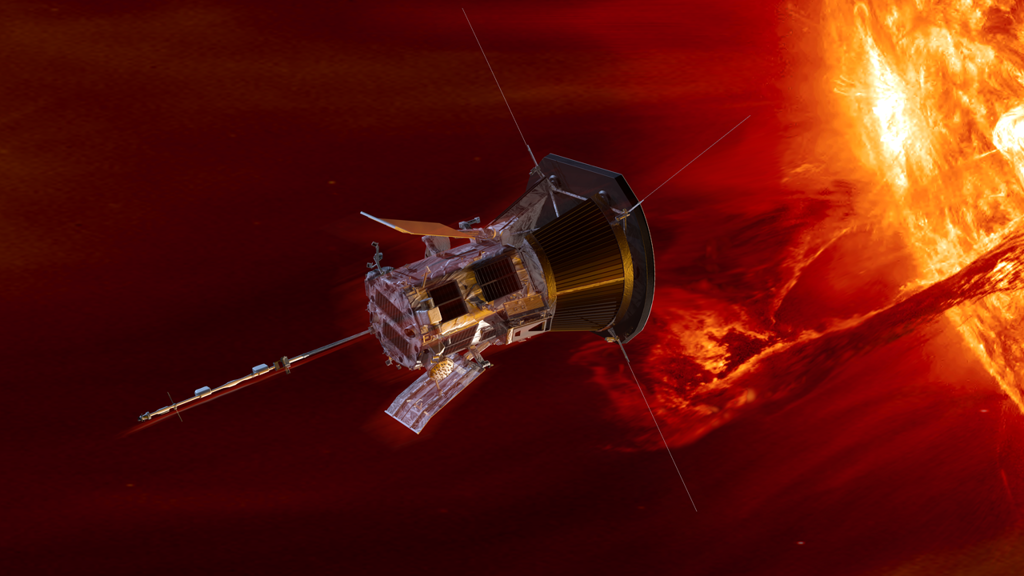
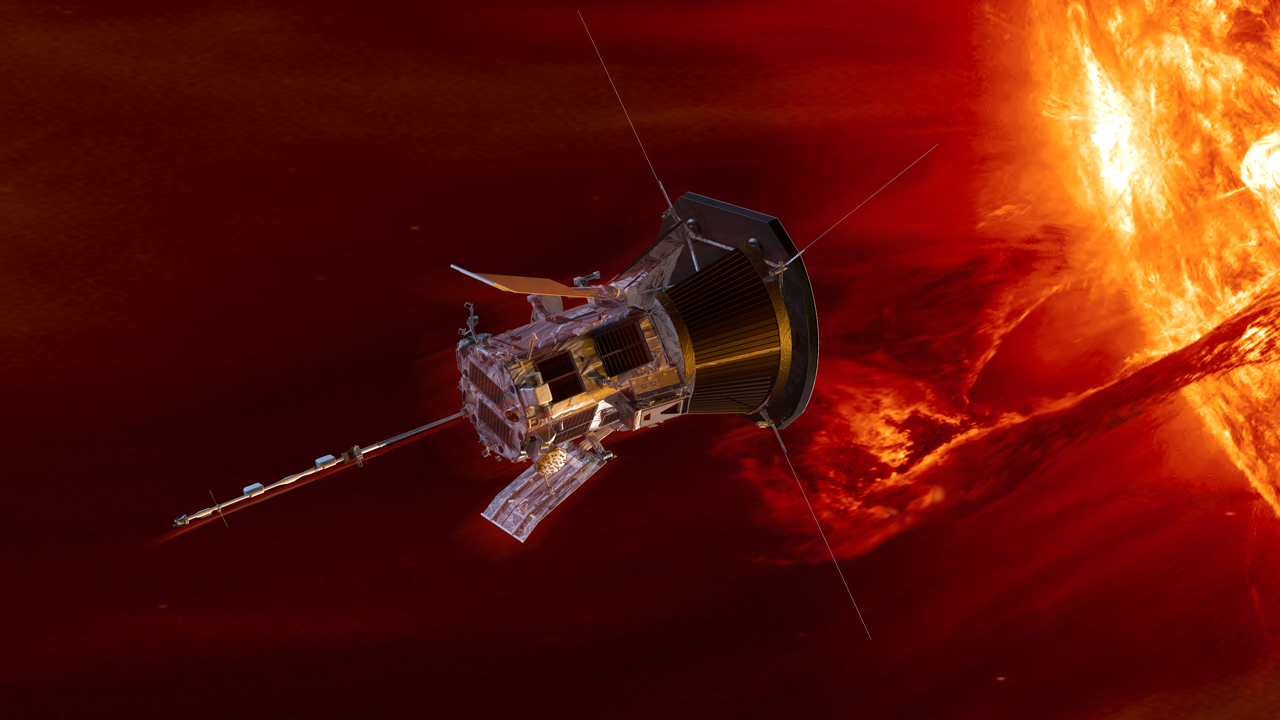
Parker Solar Probe is the first spacecraft to fly into the Sun's atmosphere. Launched in 2018, it is steadily shrinking its orbit using seven gravity-assist flybys of Venus, diving closer to the Sun than any spacecraft before it to answer a sixty-year-old puzzle: why the corona is hundreds of times hotter than the surface below it, and how the solar wind gets its speed.
Surviving so close to the Sun comes down to a single piece of engineering — an 11.4 cm carbon-composite heat shield that reaches around 1,377 °C on its Sun-facing side while keeping the instruments behind it near room temperature. The probe darts through perihelion at record speed, gathering data in the few hours it spends in the fiercest heat.
On 28 April 2021 it crossed the Alfvén surface and flew through the corona for the first time — 'touching the Sun'. On 24 December 2024 it set the all-time records it still holds: about 3.8 million miles from the solar surface at roughly 692,000 km/h, the fastest and closest any human-made object has ever travelled. It is named for Eugene Parker, who predicted the solar wind in 1958.
Mission timeline
- 2017 · May 31Renamed for Eugene Parker
NASA renames the mission in honour of solar-wind pioneer Eugene Parker — the first NASA spacecraft ever named after a living person.
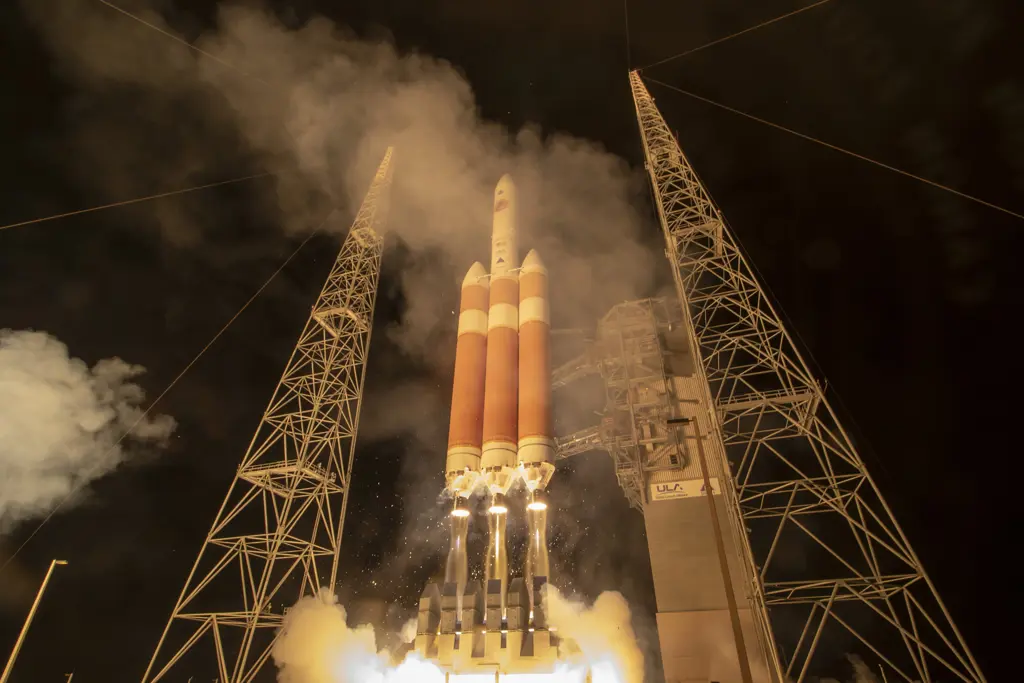
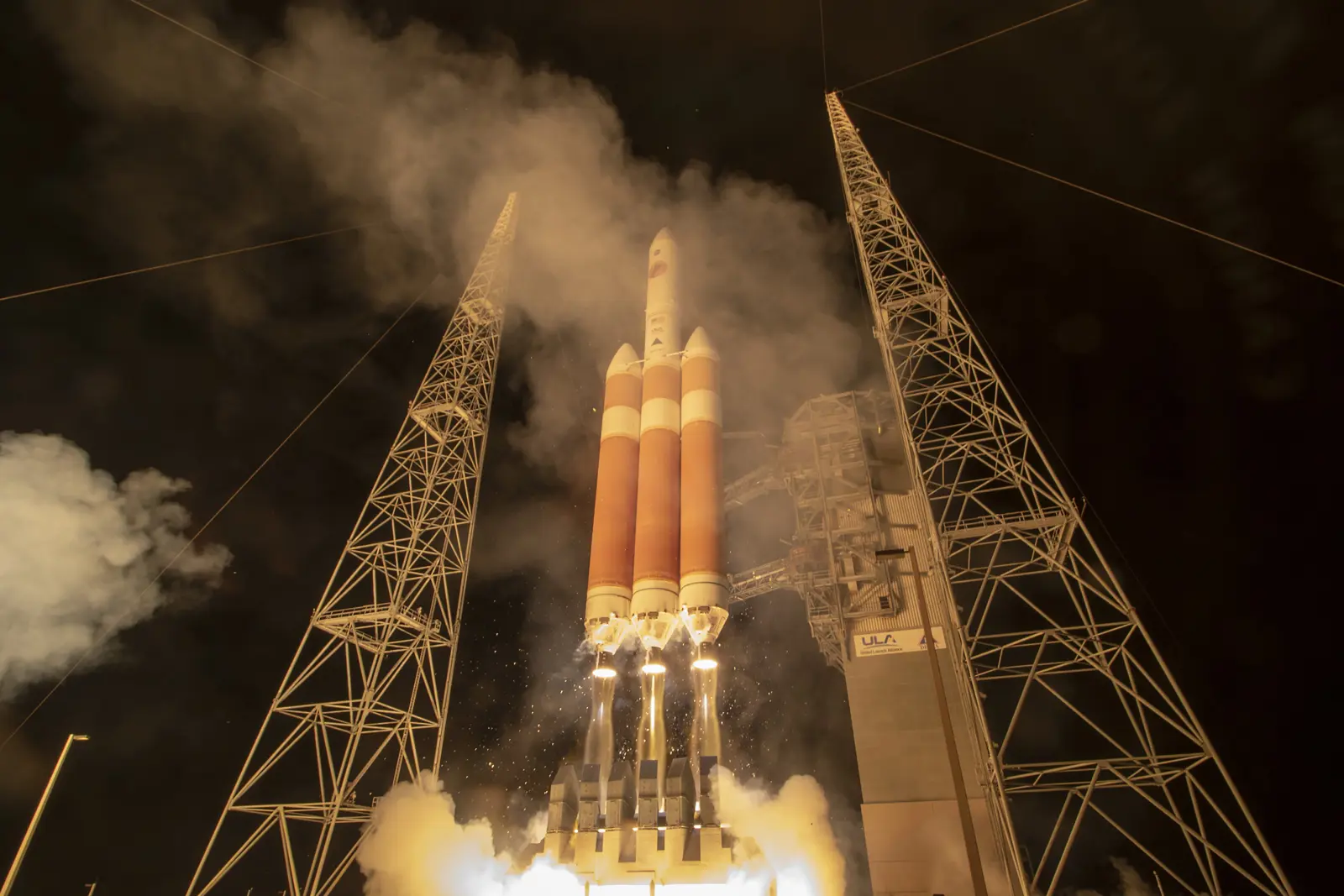
- 2018 · Aug 12Launch
Lifts off on a Delta IV Heavy — one of the most powerful launches ever, needed to fall inward toward the Sun.
- 2018 · Oct 3First Venus gravity assist
The first of seven Venus flybys begins shrinking Parker's orbit closer to the Sun.
- 2018 · Nov 5First perihelion
On its very first close pass Parker is already the closest spacecraft to the Sun in history.
- 2021 · Apr 28Touches the Sun
Parker crosses the Alfvén surface and flies through the corona for the first time — announced that December.
- 2023 · Sep 27Fastest object ever
A close pass accelerates Parker past 635,000 km/h, making it the fastest human-made object.
- 2024 · Nov 6Final Venus gravity assist
Parker's seventh and last Venus flyby tightens its orbit, setting up the record-close perihelion the following month.
- 2024 · Dec 24Record perihelion
Parker flies just 3.8 million miles from the Sun's surface at ~692,000 km/h — its closest and fastest pass yet.
- 2026 · Mar 11Matches the record
On its 27th solar pass Parker again reaches its record-close 3.8-million-mile distance from the surface.
- TodayStill circling the Sun
Parker continues its record-setting perihelia, with further close passes scheduled through 2026.
Active instruments
- Electromagnetic Fields Investigation
Measures electric and magnetic fields, plasma waves and radio emissions near the Sun
- Wide-field Imager for Solar Probe
Visible-light camera that photographs the corona and solar-wind structures from the inside
- Solar Wind Electrons Alphas and Protons
Counts and characterises the particles of the solar wind streaming past
- Integrated Science Investigation of the Sun
Measures energetic particles and how the Sun accelerates them
Headline discoveries
Parker found the near-Sun solar wind is full of sudden S-shaped reversals in the magnetic field — 'switchbacks' that trace back to the Sun's surface and help explain how the wind is energised.
By flying inside the corona's outer boundary, Parker made the first in-situ measurements of the region where the solar wind is still magnetically bound to the Sun — pinpointing where it is born.
Parker's images confirmed that interplanetary dust thins out close to the Sun, where sunlight vaporises the grains — the long-predicted dust-free zone.
Frequently asked questions
Track Parker in real time
Ride along in NASA's Eyes on the Solar System — a real-time 3D simulation of Parker's looping orbits and record-breaking dives toward the Sun.
Data: NASA/JPL — Eyes on the Solar System