New Horizons
First to Pluto, now in the Kuiper Belt
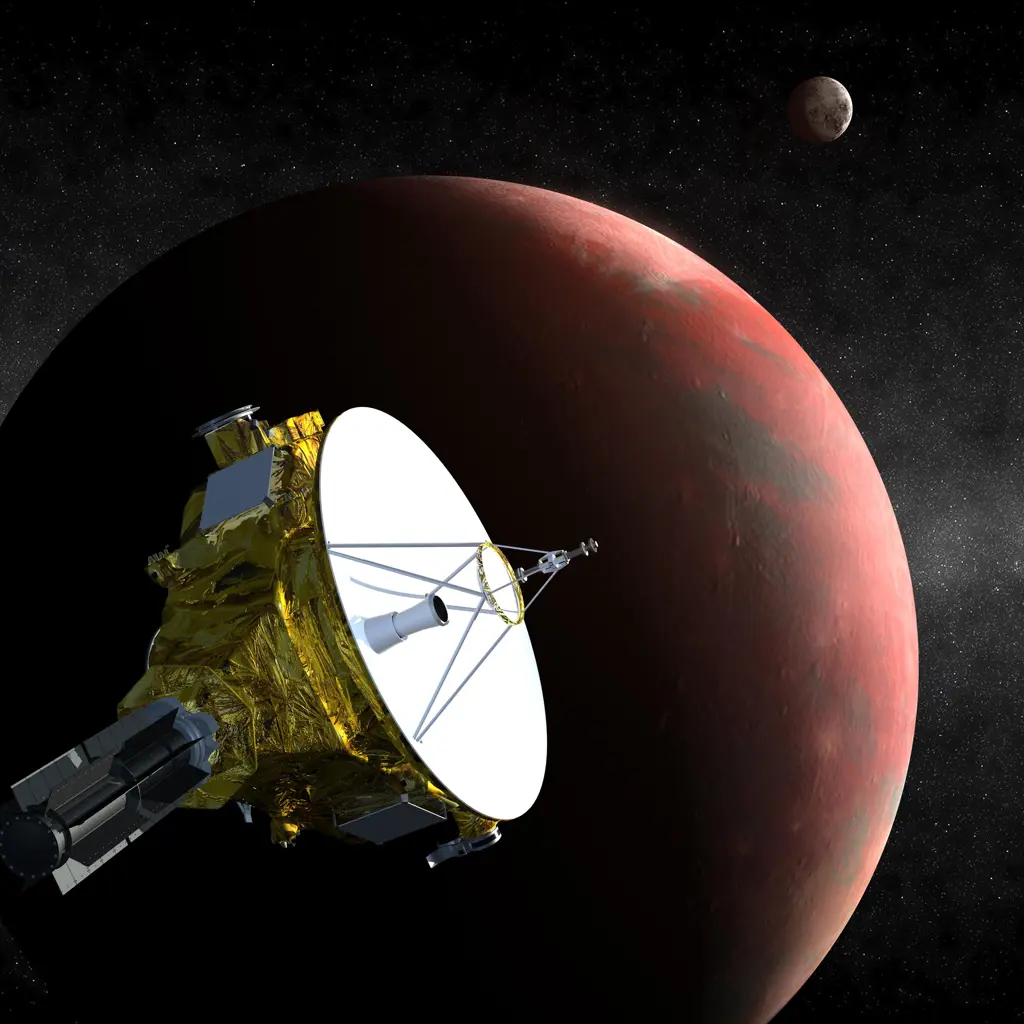
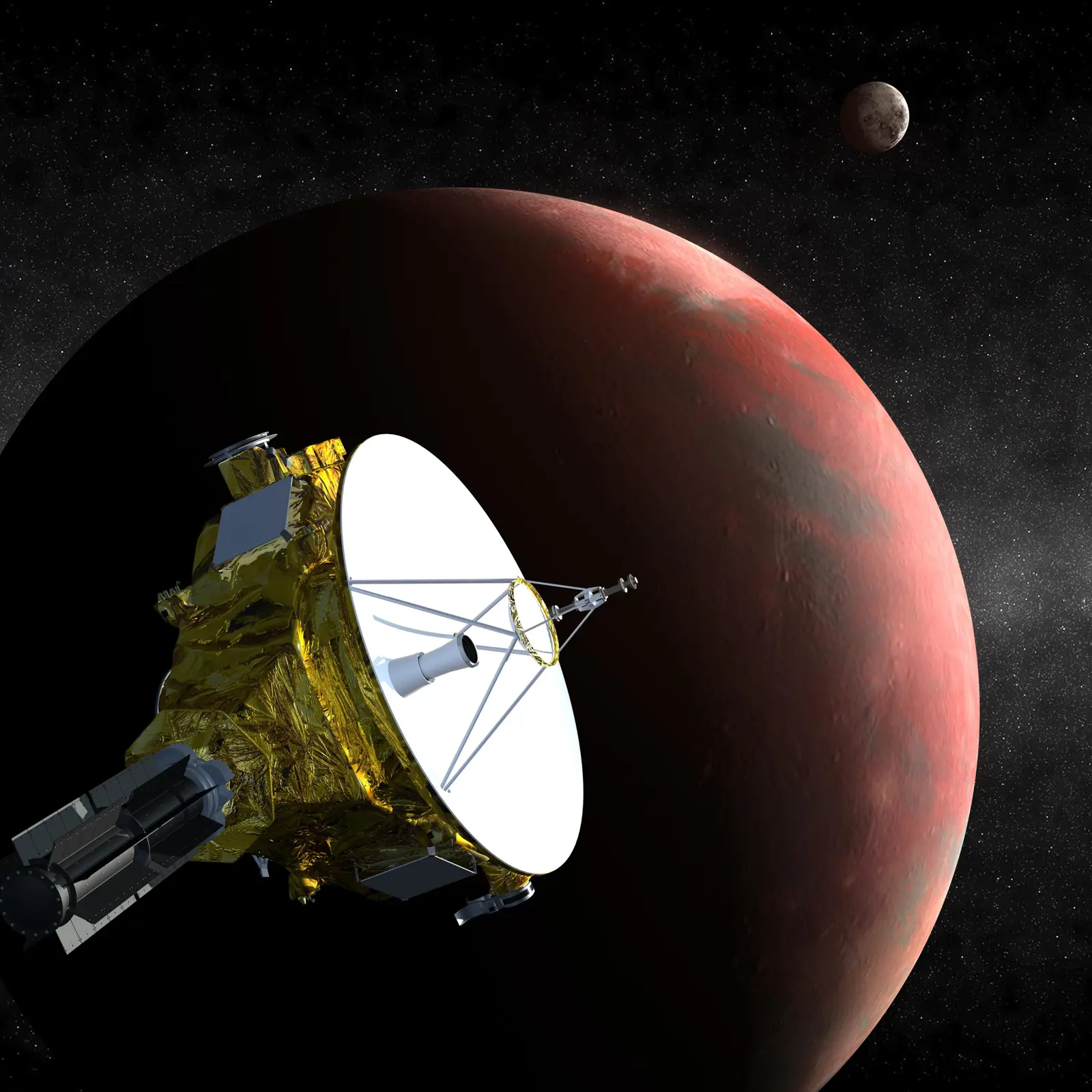
New Horizons is the first and only spacecraft to visit Pluto. It launched in January 2006 as the fastest spacecraft ever to leave Earth — fast enough to pass the Moon in nine hours — and used a 2007 Jupiter gravity assist to shorten its journey to the edge of the solar system.
On 14 July 2015, after a nine-and-a-half-year cruise, it swept 12,500 km past Pluto and transformed a fuzzy dot into a world: nitrogen-ice glaciers flowing across the bright 'heart' of Sputnik Planitia, water-ice mountains, hazes, and a system of five moons. It took sixteen months to radio all of that data home across five billion kilometres.
On New Year's Day 2019 it flew past Arrokoth, a pristine Kuiper Belt object and the most distant body ever explored up close — a two-lobed relic from the dawn of the solar system. Now nearly 60 astronomical units from the Sun and powered, like the Voyagers, by a plutonium generator, New Horizons studies the outer heliosphere and is expected to keep operating until it exits the Kuiper Belt around 2028–2029.


Mission timeline
- 2001 · Nov 29Mission selected
NASA picks the New Horizons proposal as its Pluto–Kuiper Belt mission under the New Frontiers program.
- 2006 · Jan 19Launch
Atlas V 551 hurls New Horizons away from Earth at over 16 km/s — the fastest launch in history.
- 2006 · Aug 24Pluto becomes a dwarf planet
Just seven months after launch, the IAU adopts a new definition of planet and reclassifies New Horizons' target as a dwarf planet.
- 2007 · Feb 28Jupiter gravity assist
A close pass of Jupiter adds speed and trims years off the trip, while the cameras rehearse on the giant planet and its moons.
- 2015 · Jul 14Pluto closest approach
New Horizons becomes the first spacecraft to explore Pluto, revealing an astonishingly active icy world and its moons.
- 2015 · Aug 28Next target selected
The team chooses the distant Kuiper Belt object later named Arrokoth — spotted by Hubble in 2014 — as the post-Pluto flyby target.
- 2016 · OctPluto data complete
The last bits of the flyby finally finish downlinking — sixteen months of data trickling back from five billion km away.
- 2019 · Jan 1Arrokoth flyby
Flies past the Kuiper Belt object Arrokoth — the most distant object ever explored, a perfectly preserved planetary building block.
- 2024 · OctPasses 60 AU
Crosses 60 astronomical units from the Sun — twice Pluto's distance — still healthy and returning data.
- 2025Extended heliophysics mission
With its targets behind it, New Horizons turns to measuring the dust, plasma and radiation of the outer heliosphere.
- TodayOutbound toward the edge
Still operating in the Kuiper Belt and expected to keep working until it exits around 2028–2029.
Active instruments
- Long Range Reconnaissance Imager
Telescopic black-and-white camera — the source of the iconic high-resolution Pluto close-ups
- Visible and Infrared Imager / Spectrometer
Colour images and composition maps of surfaces and ices
- Ultraviolet Imaging Spectrograph
Probes the structure and composition of Pluto's tenuous atmosphere
- Solar Wind Around Pluto
Measures the solar wind and how fast Pluto's atmosphere escapes to space
- Pluto Energetic Particle Spectrometer Science Investigation
Detects energetic particles around Pluto and through the Kuiper Belt
- Venetia Burney Student Dust Counter
Student-built instrument counting dust-grain impacts all the way across the solar system
- Radio Science Experiment
Uses the spacecraft's telecom system to probe Pluto's atmosphere and measure surface temperatures by radio occultation
Headline discoveries
Far from a frozen relic, Pluto has flowing nitrogen-ice glaciers, towering water-ice mountains, possible cryovolcanoes and a layered haze — driven by internal heat and a surprisingly active surface.
Arrokoth, a gently joined pair of lobes untouched for 4.5 billion years, showed that planetary building blocks formed by slow, gentle accretion rather than violent collisions.
New Horizons measured Pluto's escaping nitrogen atmosphere and studied its five moons, including the chaotic tumbling of the small outer satellites and Charon's deep red polar cap.
Frequently asked questions
Track New Horizons in real time
Follow New Horizons in NASA's Eyes on the Solar System — a real-time 3D simulation of its path past Pluto and out through the Kuiper Belt.
Data: NASA/JPL — Eyes on the Solar System