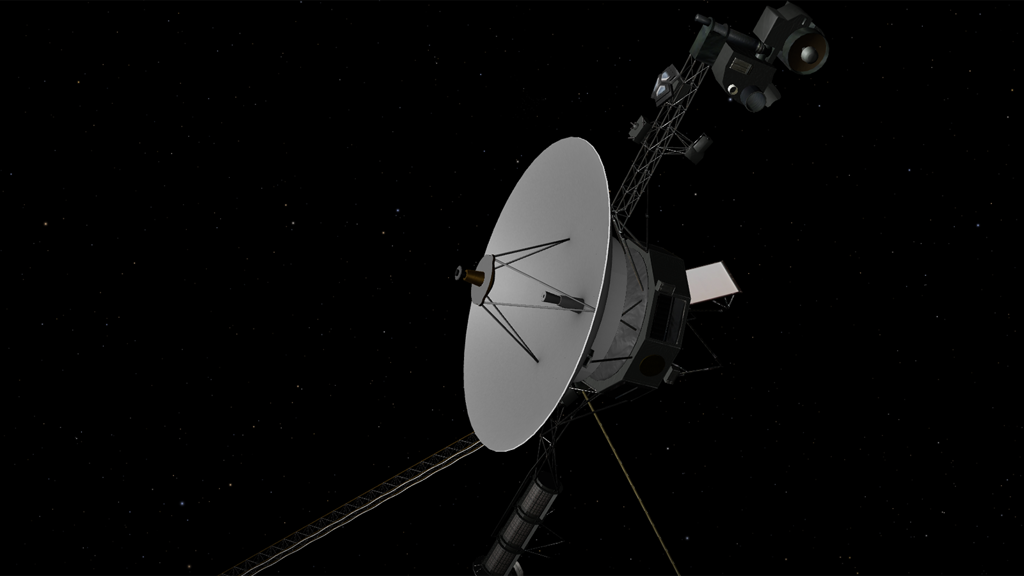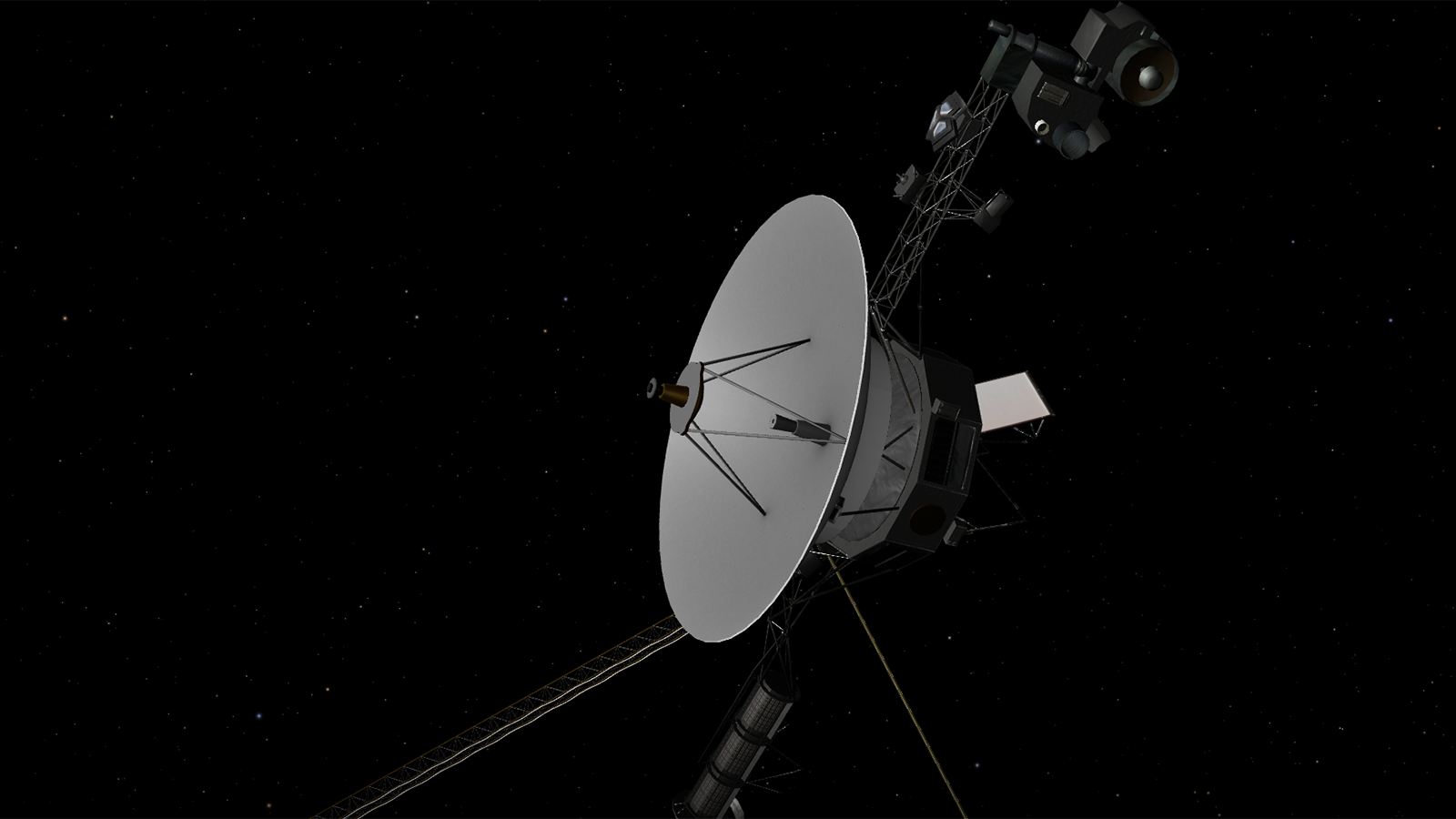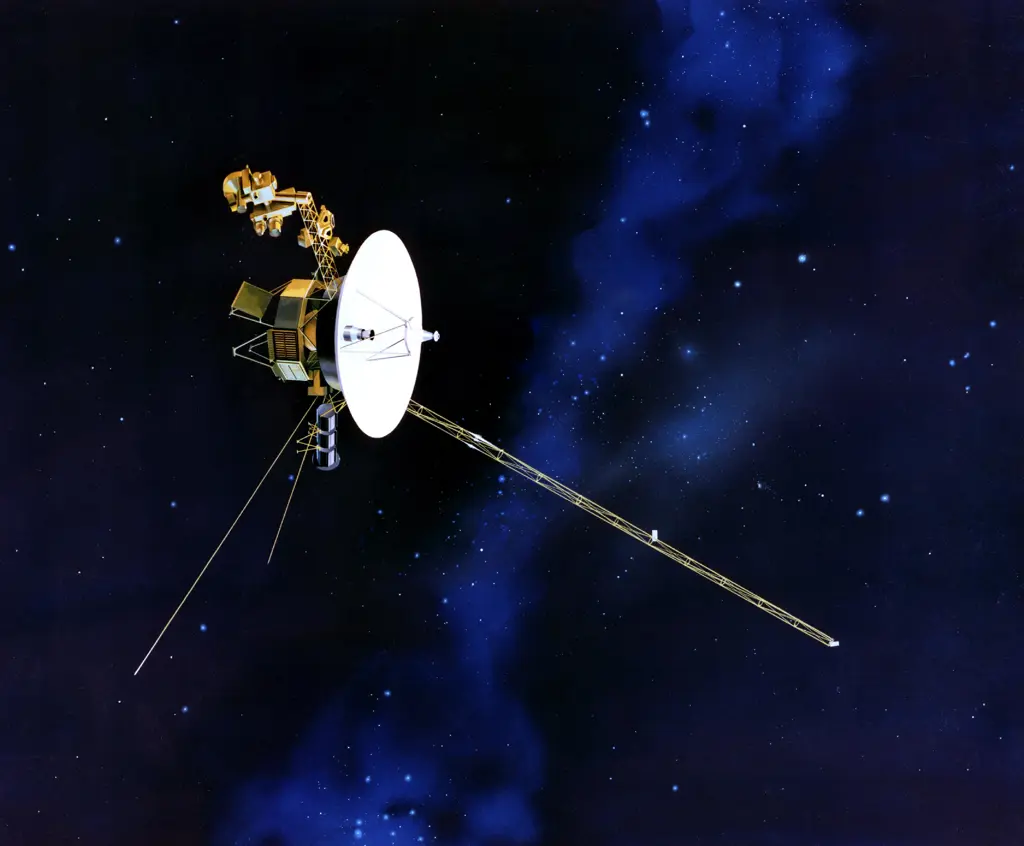
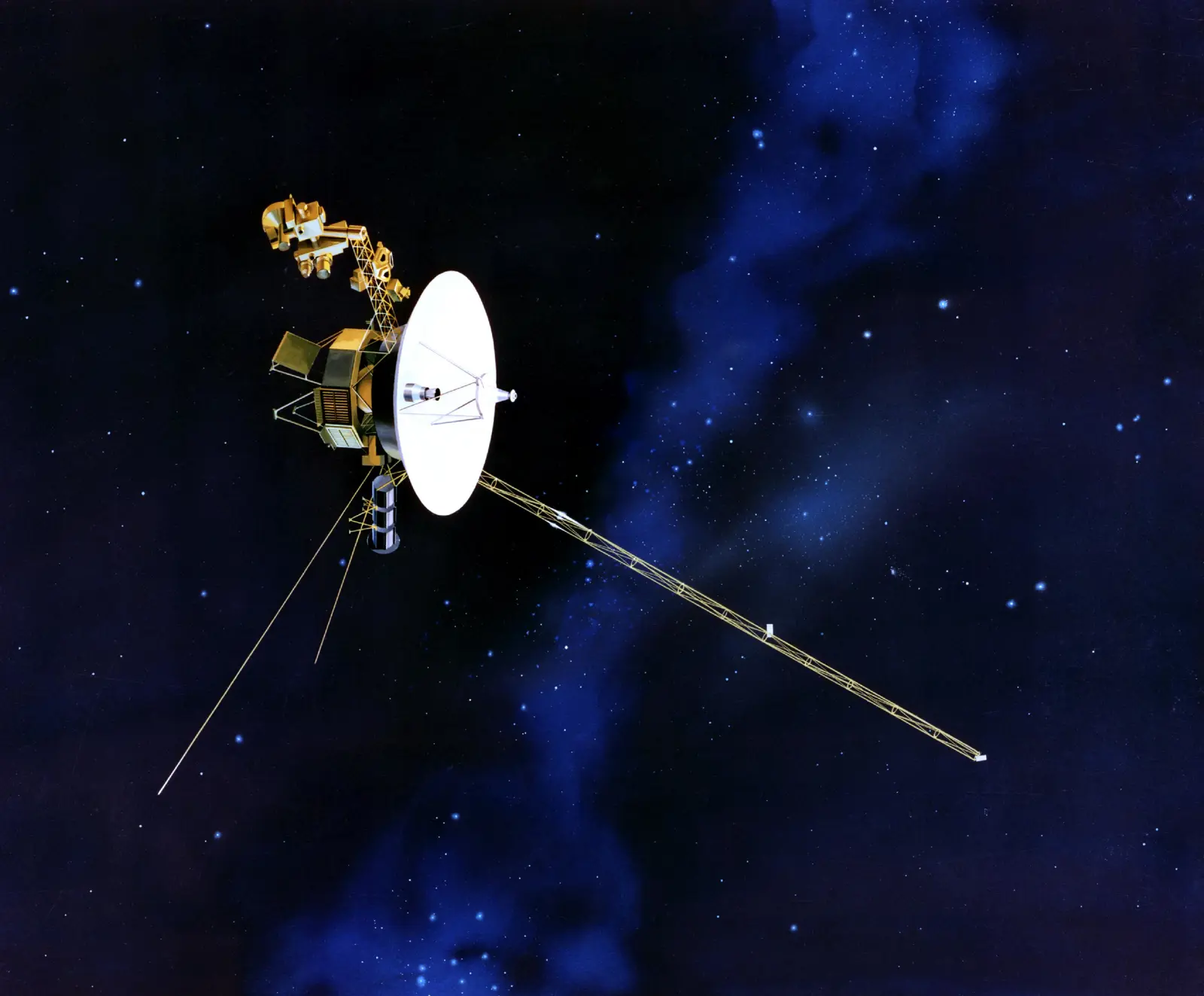
Voyager 1
The farthest human-made object from Earth
Voyager 1 launched in September 1977 on what was meant to be a four-year tour of Jupiter and Saturn. Nearly half a century later it is still flying, still talking to Earth, and the farthest human-made object ever — well past the edge of the Sun's heliosphere, deep into the interstellar medium between the stars.
Its planetary mission alone changed astronomy: the first close-up of Io's volcanoes, the first detailed images of Saturn's rings, and the discovery of Titan's thick nitrogen atmosphere. After Saturn, Voyager 1 was turned upward and away from the ecliptic — the planetary tour was over, and the interstellar mission began.
Voyager 1 is now running on a few dwindling watts from a plutonium RTG that loses about four watts each year. NASA powers down instruments one by one to stretch the mission — but as of 2026 the spacecraft is still returning magnetic-field and plasma-wave data from a place no probe has ever been before.
Mission timeline
- 1977 · Sep 5Launch
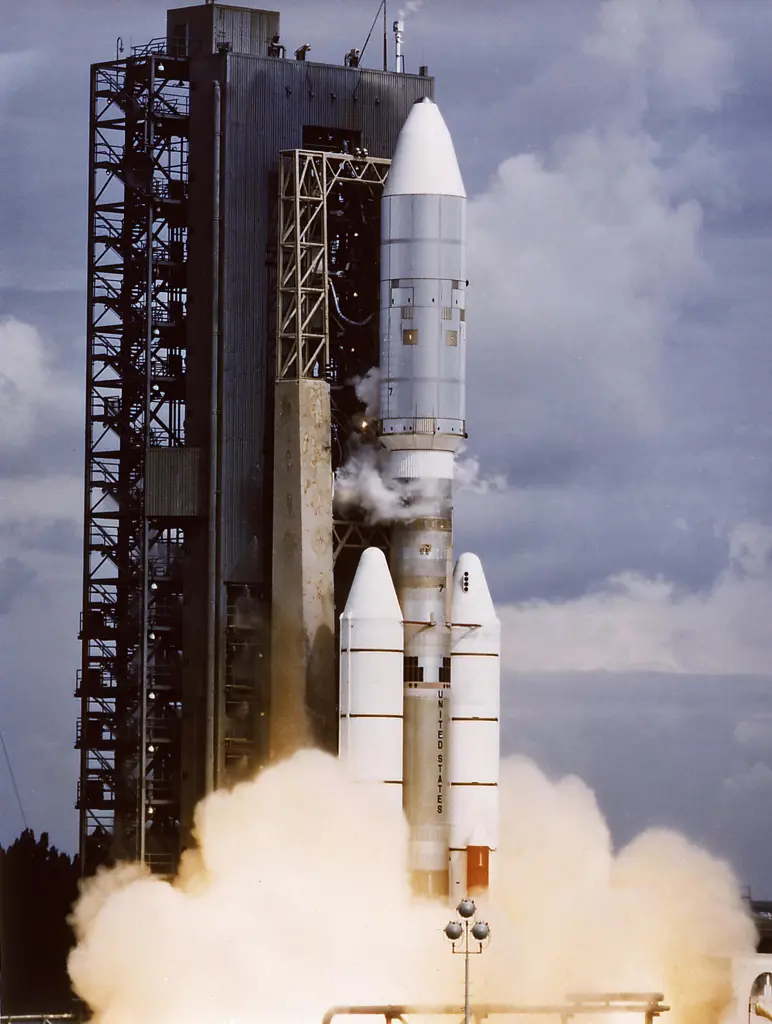
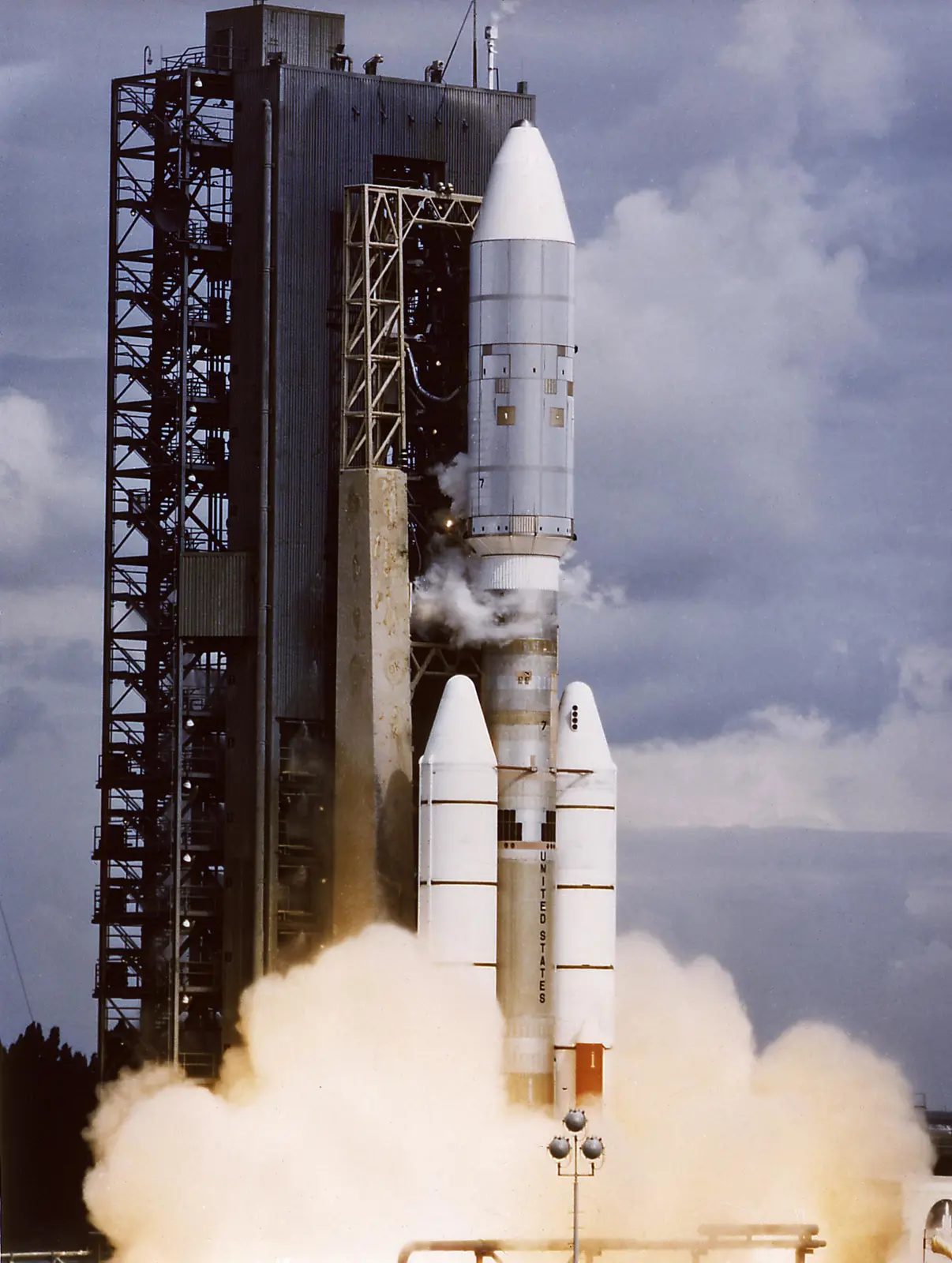
Lifted off from Cape Canaveral on Titan IIIE-Centaur, sixteen days after Voyager 2 but on a faster trajectory.
- 1979 · Mar 5Jupiter encounter
Closest approach to Jupiter — reveals active volcanism on Io, the first found anywhere beyond Earth.
- 1980 · Nov 12Saturn encounter
Skims past Saturn, returns the most detailed ring images ever taken and confirms Titan's thick atmosphere.
- 1990 · Feb 14Pale Blue Dot
Turned around for one last look home: Earth is a single pixel taken from 6 billion km away, at Carl Sagan's request.
- 1998 · Feb 17Farthest human-made object
Overtakes Pioneer 10 — Voyager 1 is now the most distant object ever sent by humans, a record it has held ever since.
- 2012 · Aug 25Crossed the heliopause
Enters interstellar space — the first spacecraft ever to leave the Sun's bubble of plasma and feel the wind between the stars.
- 2017 · NovTrajectory thrusters revived
37-year-dormant TCM thrusters fired successfully — adding years to the antenna's pointable lifetime.
- 2024 · AprRecovered from FDS glitch
Engineers identify and work around a corrupted memory chip in the Flight Data System; science telemetry resumes after five months of garbled data.
- 2025 · FebCRS turned off
Cosmic Ray Subsystem powered down to save energy — instrument count drops to three.
- 2026 · Apr 17LECP turned off
Low-energy Charged Particle instrument shut down after 49 years; only the magnetometer and plasma-wave subsystem still operate.
- TodayStill in the interstellar wind
Power decay forces hard choices each year — but Voyager 1 continues to whisper back from beyond the heliosphere.
Instruments today
- Magnetometer
Measures the interstellar magnetic field — still operational
- Plasma Wave Subsystem
Detects density waves in the interstellar plasma — confirmed the 2012 heliopause crossing
- Low-Energy Charged Particle Detector
Charged-particle detector for solar and galactic particles — turned off April 2026
- Cosmic Ray Subsystem
Galactic cosmic-ray spectrometer — turned off February 2025
- Imaging Science Subsystem
Twin narrow- and wide-angle vidicon cameras — powered down in 1990 after the Pale Blue Dot
Headline discoveries
Voyager 1's flyby imagery showed a sulphur-spewing plume on Jupiter's moon Io — the first volcanic activity ever observed beyond Earth.
Spokes, braids, shepherd moons and intricate structure within the rings — revealed for the first time by Voyager's close pass in 1980.
In August 2012 Voyager 1 measured the abrupt jump in plasma density that marks the boundary between the Sun's heliosphere and interstellar space — the first direct measurement of that frontier.
Related videos
Track Voyager 1 in real time
Fly alongside Voyager 1 in NASA's Eyes on the Solar System — a real-time 3D simulation of the most distant human-made object from Earth.
Data: NASA/JPL — Eyes on the Solar System